 Deutsch
 العربية
 中文
 Français
 English
 Español
 Italiano
 Türkçe
Plants for low light: what grows in a dim home
No houseplant lives in darkness, but quite a few cope well with a room that never sees direct sun. The trick is knowing how much light a spot really gets, choosing plants that tolerate it and adjusting care: less water, no feeding, clean leaves. This guide covers all of it.

- Difficulty
- Easy
- Low light
- About 50–250 foot-candles (estimated)
- Watering
- Less often than in bright rooms
- Toughest picks
- ZZ plant, snake plant, pothos
What “low light” really means
Low light is not no light. It means a spot that gets no direct sun and only weak daylight: a north-facing room, a corner far from the window, or a window shaded by buildings or trees.
- Distance matters most. Light drops off quickly as you move away from glass. A plant 6–8 ft from a window often gets only a fraction of the light on the sill (estimated).
- Window direction: in the Northern Hemisphere, north windows give the softest light, east gives gentle morning sun, south and west are the brightest.
- Light meter apps on a phone can give a rough reading. Low light is roughly 50–250 foot-candles; bright indirect light is closer to 250–1,000 (estimated). Phone sensors vary, so treat the numbers as a guide, not a measurement.
A room without any window is a different case: there, plants need a grow light to survive long term.

A simple way to measure light: the shadow test
You don't need a meter. Your own hand and a sheet of paper tell you a lot.
- Pick a time around midday on a bright day; overcast days give lower readings.
- Put a sheet of white paper where the plant will stand.
- Hold your hand about 12 in above the paper.
- Sharp, clearly outlined shadow: bright light. Most low-light plants would be happy here too.
- Soft shadow with fuzzy edges: medium to low light — suitable for every plant in this guide.
- Barely visible shadow: very low light. Only the toughest plants (ZZ, snake plant) cope, and a grow light helps.
- Repeat in winter; the same spot can be much darker when the sun is low.
Plants that tolerate low light
These plants come from forest floors or similar shaded habitats. They tolerate low light; most still grow faster with a bit more.


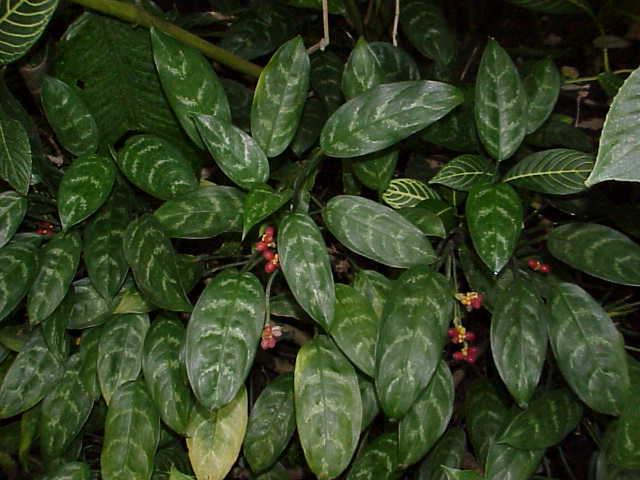

How care changes in low light
Less light means slower growth, and a slow plant uses less water and food.
- Water less often. Soil dries much more slowly. Check with a finger and water only when the top 1–2 in are dry (for ZZ and snake plant, wait until fully dry).
- Skip fertiliser or use very little in spring and summer; unused fertiliser builds up as salts in the soil.
- Dust the leaves every few weeks with a damp cloth; a dust layer blocks some of the little light there is.
- Rotate the pot a quarter turn every week or two so the plant doesn't lean towards the window.
- Use a pot with a drainage hole and a free-draining mix; wet soil in a dim room easily leads to root rot.

Artificial light: LED grow lights
When a spot is too dark, a small LED grow light fixes the problem. A full-spectrum (white) LED looks natural in a living room and is enough for foliage plants. Use a timer so the schedule stays regular.
Distance (estimated)
- Small clip-on LED: 6–12 in above the leaves
- Stronger panel: 12–24 in
- Leaves bleaching or yellowing: move it further away
Duration (estimated)
- Supplementing weak daylight: 6–8 hours a day
- Windowless room: 10–12 hours a day
- Leave at least 8 hours of darkness
Signs of too little light
Where to put plants in a dim home
Even inside a dark flat, some spots are much better than others.
Better spots
- Right next to a north or east window
- Light-coloured rooms where walls reflect light
- Near a mirror opposite a window
- On a stand at sill height rather than on the floor
Harder spots
- Corners several feet from any window
- Behind thick curtains
- Below the window sill line
- Hallways and rooms without windows (grow light needed)
A note on pets
Several popular low-light plants are not safe for cats and dogs. ZZ plant, pothos, peace lily, aglaonema, philodendron and snake plant can cause mouth irritation and stomach upset if chewed. Parlor palm, Boston fern and calathea are generally listed as non-toxic.

⚠️ If your pet chews a plant or shows any symptoms, contact your vet straight away.
Common mistakes
- Watering on a fixed schedule copied from a bright room.
- Moving a shade-grown plant straight into strong sun; leaves can scorch. Increase light over 1–2 weeks.
- Expecting flowers: peace lily and others flower much less in low light.
- Repotting into a much larger pot; extra soil stays wet for longer.
Frequently asked questions
Can a plant live in a room with no windows?
Not on room lighting alone for long. With a grow light on a timer for 10–12 hours a day (estimated), ZZ plant, pothos and snake plant can do well.
Are phone light meter apps accurate?
Only roughly. They are useful for comparing two spots in your home, but the numbers can be off. Use them together with the shadow test.
Which is the easiest low-light plant?
ZZ plant and snake plant. Both tolerate dim light and irregular watering.
Do low-light plants need less water?
Usually yes. Slower growth means slower drying soil. Always check the soil instead of watering by the calendar.
Will my plant grow faster if I move it to the sun?
Brighter indirect light speeds growth, but sudden direct sun can scorch leaves. Make the change gradually.
Low-light plants on PlantWhy
ZZ PlantSnake PlantPothosChinese EvergreenParlor PalmPeace lilyHeartleaf PhilodendronCalathea
Sources
- UC Master Gardeners (UC ANR) — Pets and plants
- University of Illinois Extension — Houseplants: Lighting
Last updated: 2 November 2026